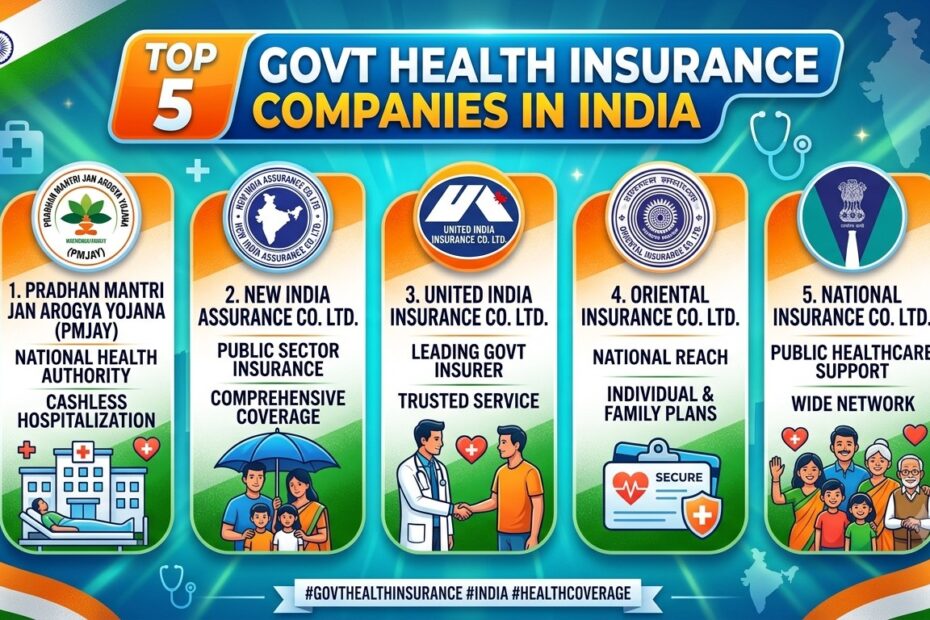
Top 5 Government Health Insurance Companies in India: Medical emergencies arrive unannounced, and the escalating cost of healthcare can easily drain a family’s hard-earned savings. While the Indian insurance market features numerous private players utilizing aggressive digital marketing and flashy smartphone applications, government health insurance companies in India remain the gold standard of trust and reliability for millions of citizens.
Public Sector Undertakings (PSUs) specialize in delivering extensive medical protection without the high premium markups often associated with private entities. Backed by the state, these organizations offer unmatched financial security, high claim approval rates, and transparent policies.
If you want a dependable safety net that prioritizes welfare over corporate profit margins, public sector options are excellent. This comprehensive guide covers the top government-backed health insurance entities in India, details their flagship plans, and highlights how to choose the right policy for your family’s well-being.
Also Read: best-health-insurance-plans-in-india-2026-for-senior-citizens
The Core Advantages of Choosing Public Sector Health Insurance
Before exploring the individual companies, it helps to understand why millions of Indian households choose state-backed insurers over private alternatives. Public sector health insurance offers distinct structural advantages that private platforms struggle to replicate.
1. High Claim Reliability and Transparency
Public sector entities prioritize genuine settlement over strict commercial profit margins. When you submit a valid claim to a government insurer, the processing tends to be transparent and fair. Because these companies do not answer to private shareholders demanding higher profit margins, the fear of arbitrary claim rejections is significantly lower.
2. Affordable and Stable Premium Rates
PSU health insurance plans are explicitly structured to remain affordable for the general public. Their pricing frameworks focus on social welfare, keeping premiums accessible for middle-class families, small business owners, rural communities, and senior citizens. Furthermore, premium increases over time tend to be more regulated and predictable than the steep hikes seen in the private market.
3. Expansive Ground Network and Rural Penetration
Decades of operation give government insurers deeply rooted relationships with hospitals nationwide. While private insurers focus heavily on corporate, multi-specialty hospitals in major metropolitan areas, public sector insurers maintain vast networks that extend deep into Tier-2, Tier-3, and rural sectors. This makes them highly practical for individuals living outside major cities.
4. Lifelong Renewability and Lack of Hidden Clauses
Government medical policies follow strict guidelines set by the Insurance Regulatory and Development Authority of India (IRDAI), but they also feature straightforward wordings. You rarely encounter convoluted legal jargon or hidden riders that limit your coverage during an emergency. Most public plans offer assured lifelong renewability, protecting your health as you age.
Also Read: best-health-insurance-plans-in-india-2026.
Profiles of the Top 5 Government Health Insurance Entities in India
Here is an in-depth analysis of the leading state-backed insurance institutions and major public health initiatives operating across India today.
1. The New India Assurance Company Limited
As a pioneer in the Indian insurance landscape since 1919, The New India Assurance Company Limited stands as the largest public sector general insurer in the country. Founded by Sir Dorabji Tata and nationalized in 1973, it commands a dominant market share and operates an expansive network across domestic and global territories.
- Headquarters: Mumbai, Maharashtra
- Key Advantage: Exceptional global reputation, dominant market presence, and highly stable long-term operations.
- Flagship Plans: New India Mediclaim Policy and the youth-focused Yuva Bharat Health Policy.
- Cashless Network: Features thousands of empanelled hospitals across every state in India.
- Ideal For: Families seeking established, corporate-grade health protection that stays stable over decades.
The New India Mediclaim Policy is a versatile option offering robust coverage for hospitalization expenses, pre- and post-hospitalization costs, and specific modern treatments. It is favored by individuals who prefer a traditional, reliable policy backed by an insurer with massive financial reserves.
2. United India Insurance Company Limited
Incorporated in 1938, United India Insurance Company Limited is famous for its massive rural and semi-urban footprint. Following the merger of several cooperative insurance societies and foreign entities, the company excels at designing simple, high-utility products tailored for the middle-class segment.
- Headquarters: Chennai, Tamil Nadu
- Key Advantage: A massive cashless hospital network exceeding 14,000 providers, ensuring excellent coverage in Tier-2 and Tier-3 cities.
- Flagship Plan: UNI Family Medicare Policy.
- Regional Strength: Exceptionally strong administrative and hospital network across Southern and Central India.
- Ideal For: Multi-generational families who want local, accessible cashless treatments across regional India.
The UNI Family Medicare Policy provides a convenient family floater option, allowing a single sum insured to cover multiple family members. This plan helps reduce total premium costs while ensuring that any member can access high-quality healthcare when needed.
3. National Insurance Company Limited
Holding the title of India’s oldest general insurance enterprise (established in 1906), National Insurance Company Limited brings over a century of service expertise. Headquartered in the eastern part of the country, they specialize in straightforward, consumer-friendly policies.
- Headquarters: Kolkata, West Bengal
- Key Advantage: Deep penetration into the heartland of India, providing high-value financial safety nets where corporate insurers rarely venture.
- Flagship Plans: National Mediclaim Policy and Parivar Mediclaim.
- Core Value: Simplicity in documentation and easy-to-understand policy terms.
- Ideal For: Budget-focused individuals searching for traditional, reliable medical coverage without complex riders.
The National Mediclaim Policy covers standard inpatient hospitalization expenses, including nursing funds, room rent, and intensive care unit (ICU) charges. It strips away unnecessary cosmetic additions, delivering an affordable plan that handles core medical costs efficiently.
4. The Oriental Insurance Company Limited
Founded right at the dawn of independence in 1947, The Oriental Insurance Company Limited built its reputation on robust commercial and heavy-industry insurance before perfecting its retail health policies. The company is known for its highly professional corporate group health covers.
- Key Advantage: Highly efficient internal systems for settling complex medical claims smoothly and managing massive corporate portfolios.
- Flagship Plan: Oriental Happy Family Floater.
- Specialized Offerings: Excellent optional add-ons, including coverage for critical illnesses and personal accidents.
- Ideal For: Salaried professionals looking for tailored critical illness riders and reliable family floater setups.
Ideal For: Salaried professionals looking for tailored critical illness riders and reliable family floater setups.
The Oriental Happy Family Floater plan offers multiple variants (Silver, Gold, and Diamond) to fit different budget levels. This allows buyers to customize their policy by choosing their preferred room category limits, co-payment options, and add-on benefits.
5. Ayushman Bharat – Pradhan Mantri Jan Arogya Yojana (PMJAY)
Distinct from the commercial PSUs listed above, PMJAY is a state-funded national health assurance scheme. Developed by the Central Government and managed by the National Health Authority (NHA), it represents the world’s largest fully funded public health insurance program.
- Headquarters: New Delhi (National Health Authority)
- Key Advantage: 100% free, cashless, and paperless medical care at all empanelled public and private hospitals nationwide.
- Coverage Blueprint: Provides ₹5 Lakh per family annually for secondary and tertiary hospitalization needs.
- Target Demographic: Over 12 crore vulnerable and lower-income families identified by socioeconomic criteria.
- Ideal For: Low-income families, daily wage earners, and citizens classified under vulnerable socioeconomic groups.
PMJAY covers pre-existing conditions from day one, eliminating the waiting periods standard in commercial policies. It includes medical examinations, treatment, consultations, pre-hospitalization expenses, and post-hospitalization care up to 15 days, providing an essential safety net for those who cannot afford traditional insurance.
Also Read : pradhanmantri-jeevan-jyoti-bima-yojana.
Retail Insurance Policies vs. Social Welfare Schemes: Clarifying the Difference
If you earn a steady income as a professional, business owner, or salaried worker, your path involves purchasing a retail insurance product from commercial PSUs like New India Assurance or Oriental Insurance. You pay an annual premium based on your age and chosen sum insured.
Conversely, if you belong to an economically vulnerable demographic or live in identified rural areas, you may qualify directly for government welfare schemes like PMJAY, which require zero premium contributions and provide pre-approved cards for cashless hospital treatments.
Crucial Tips for Choosing the Right Government Plan
Before finalizing your state-backed health insurance policy, review these vital parameters to optimize your investment:
- Verify the Local Cashless Network: An insurance policy is only as good as its accessible hospitals. Always check the insurer’s active cashless panel to verify that your preferred neighborhood hospitals or trusted regional multi-specialty centers are included.
- Analyze the Incurred Claim Ratio (ICR): Research the company’s annual ICR percentages published by the IRDAI. A healthy, balanced ratio (typically between 75% and 90%) indicates that the organization actively disburses claims to its policyholders while maintaining financial stability.
- Check Room Rent Limits and Sub-Limits: Read the fine print to identify any specific caps on daily hospital room allowances. Older government plans sometimes limit room rent to 1% of the total sum insured per day. Choosing a policy with relaxed or no sub-limits helps you avoid unexpected out-of-pocket costs during hospital discharge.
- Understand Waiting Periods for Pre-existing Conditions: Commercial government policies usually require a waiting period (often 3 to 4 years) before covering pre-existing illnesses like diabetes or hypertension. Plan ahead and buy early to clear these waiting periods while you are healthy.
Final Thoughts
Investing your capital into a government health insurance company in India provides a unique combination of affordability, extensive coverage, and unparalleled public trust. Whether you opt for market leaders like New India Assurance, leverage the wide regional network of United India, or qualify for the revolutionary PMJAY scheme, you are choosing long-term stability over flashy commercial marketing.
Take the time to map out your family’s specific healthcare requirements, cross-reference local network hospitals, and select a policy that gives you absolute peace of mind during tough times.
Which of these trusted government providers aligns best with your family’s healthcare strategy? Share your thoughts or questions in the comments below!
You are heartily welcome to our blog! We are four friends who run a Common Service Center (CSC) in India. We help people take advantage of the schemes of the Central and State Governments of India. On this blog, we authentically reach people with real and true information about government schemes. Our Official email is supportteam@bharatsarkarsuvidha.com